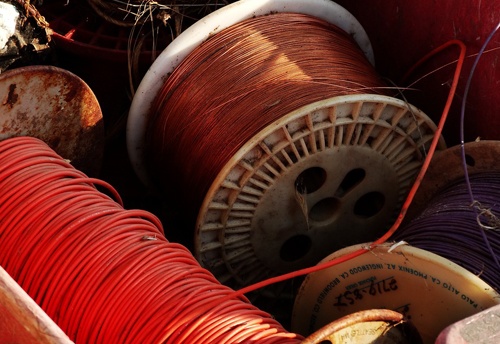
Copper Wire Color Codes: What the Sheathing Tells You
TL;DR: Copper wire sheathing colours encode the conductor’s function — live, neutral, or earth. Singapore follows the IEC 60446 standard used by the UK and EU: brown = live, blue = neutral, green/yellow striped = earth. Older wiring follows legacy colours (red = live, black = neutral). US wiring uses black/white/green. For scrap sorting, the colour doesn’t change the copper content — we buy all sheathed copper wire as #3 braziery regardless of colour.
Copper wire is colour-coded for a reason — electrical safety. But for scrap sellers and contractors, sheathing colour also acts as a visual grade signal: an electrician looking at a coil of wire can tell at a glance whether it’s an old UK-standard installation, a modern IEC-compliant run, or imported US equipment. This guide explains every common standard, why it matters for resale, and how Molten Steel handles mixed-colour loads. For deeper grading context see our copper scrap grades guide.
The IEC 60446 Standard (Singapore, UK, EU Since 2004)
Singapore’s Code of Practice (CP5) for electrical installations aligns with the IEC 60446 / BS 7671 colour convention, harmonised across Europe since 2004. The standard applies to all new installations.
| Conductor | Colour | Symbol |
|---|---|---|
| Live (Line) | Brown | L |
| Neutral | Blue | N |
| Earth (Protective Earth) | Green with yellow stripe | PE |
| Three-phase L1 | Brown | L1 |
| Three-phase L2 | Black | L2 |
| Three-phase L3 | Grey | L3 |
If you are buying building wire today in Singapore — whether from a DIY store in Balestier, an electrical wholesaler, or imported from Europe — these are the colours you’ll see.
The Legacy UK / Old Singapore Standard (Pre-2004)
Before the IEC harmonisation, British and Singaporean installations used a different single-phase convention. You still find this in HDB blocks built before the mid-2000s, older shophouses, and industrial plant from the 1980s–90s. During rewiring or demolition, these older colours often appear in the scrap stream.
| Conductor | Legacy UK/SG colour |
|---|---|
| Live | Red |
| Neutral | Black |
| Earth | Green (solid) or green/yellow striped |
| Three-phase (old) | Red / Yellow / Blue |
If you are a licensed electrician working on a legacy installation, note that old ‘black = neutral’ collides with new ‘black = L2’ — a known safety hazard at the transition. CP5 requires clear labelling during any rewiring to avoid confusion.
The US / North American Standard
Imported US equipment and some datacomm installations use the NEC (US National Electrical Code) convention:
| Conductor | US colour |
|---|---|
| Hot (Live) | Black, red, or blue |
| Neutral | White or grey |
| Ground (Earth) | Green, green/yellow, or bare copper |
| Three-phase (208V) | Black / Red / Blue |
| Three-phase (480V) | Brown / Orange / Yellow |
US-spec wiring appears in Singapore mainly through imported machinery, DJ/AV equipment, and some IT racks sourced via the US market.
Why Colour Matters for Scrap Resale
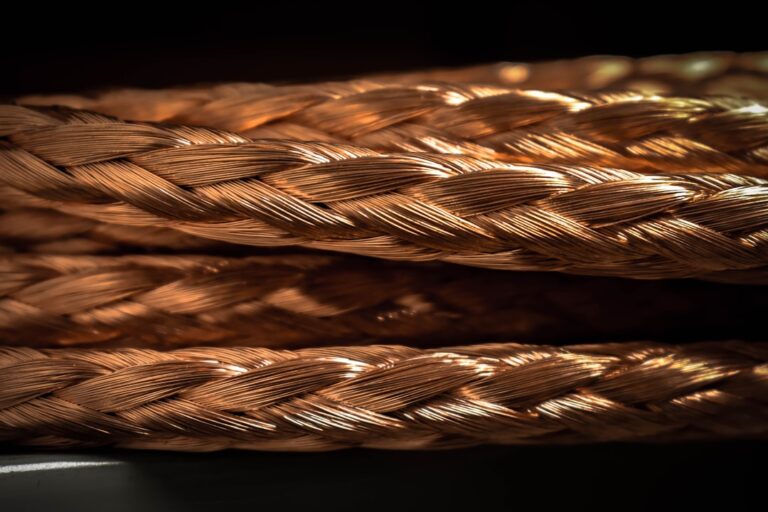
Strictly speaking, the colour of sheathing does not change the copper content or its scrap value. We buy all insulated copper wire as #3 braziery regardless of the jacket colour, at current rates of around S$4.20–6.00/kg (April 2026).
However, colour acts as a visual grade signal for experienced buyers:
- Green/yellow striped = earth wire. Often runs in bundles alongside larger live/neutral conductors. If you see a lot of it in a scrap lot, there is probably a lot of copper nearby.
- Uniform brown and blue = modern single-phase building wire. Typical gauge 2.5–6 mm². High copper-to-plastic ratio, so the load pays well.
- Black/red/grey bundle = three-phase distribution, larger gauges, typically more copper per kilogram of cable.
- White/grey PVC exterior with colour cores = twin-and-earth or armoured cable. Can be excellent scrap if the armouring is steel — two metals in one job.
Mixed Coloured Loads — Sorting vs Selling As-Is
Because we pay on copper content, not sheathing colour, there is no financial penalty for bringing a mixed load. Sellers sometimes ask whether they should sort by colour — the honest answer is: only sort by thickness.
- Thick gauges (6 mm² and up) have more copper per kg of cable and therefore pay more per weighed kilo.
- Thin gauges (1 mm², 1.5 mm²) are lower-paying because the plastic-to-copper ratio is unfavourable.
- Whether the thick cable is brown, red, black, or striped makes no difference.
If you have a high volume of thick-gauge cable (say, 100+ m of 16 mm²), it may pay to strip it — see our wire stripping cost-benefit guide.
Coloured Insulation Types You’ll Encounter
| Insulation type | Appearance | Common use |
|---|---|---|
| PVC | Uniform matte colour, flexible | Most building and appliance wire |
| XLPE (cross-linked PE) | Slightly glossy, tougher | Underground and armoured cable |
| Rubber / EPR | Soft, often matte black | Mining, welding, ship cable |
| Silicone | Glossy, high-temp tolerant | Ovens, industrial heating |
| Enamel (magnet wire) | Very thin, usually brown or red | Motor windings, transformers |
Magnet wire is a special case — the coating is enamel, not plastic, and it’s graded separately from braziery. See our copper wire scrap types guide for the full breakdown.
Safety Note for Contractors
If you are cutting wire for disposal from a live installation, always verify isolation with a proven voltage tester — never rely on colour alone. Colour conventions are a labelling aid, not a substitute for lockout/tagout procedures. CP5 applies.
FAQ
Does the sheathing colour of copper wire affect its scrap value?
No. Scrap value is based on copper content, gauge, and insulation type — not sheathing colour. Molten Steel buys all insulated copper wire as #3 braziery at S$4.20–6.00/kg regardless of whether the jacket is brown, blue, green/yellow, red, or black.
What colour is live wire in Singapore?
In modern installations following CP5 / IEC 60446 (post-2004), live is brown, neutral is blue, and earth is green with yellow stripes. Older legacy installations use red for live, black for neutral, and green for earth.
Is US wire different from Singapore wire?
Yes. US wiring follows the NEC convention: black, red, or blue for hot; white or grey for neutral; green or bare copper for ground. If you have a mixed import/local lot, we buy it all at the same braziery rate.
Related reading
- Copper Wire Scrap Types Guide
- Copper Scrap Grades Singapore Guide
- How to Strip Copper Wire for Scrap
- Copper Scrap Buying Service
- Clean vs Dirty Scrap Grading Explained
- Scrap Metal Glossary
Sell your scrap today. Molten Steel buys at LME-benchmarked rates across Singapore. Call +65 9106 7577 or WhatsApp.